About the Book
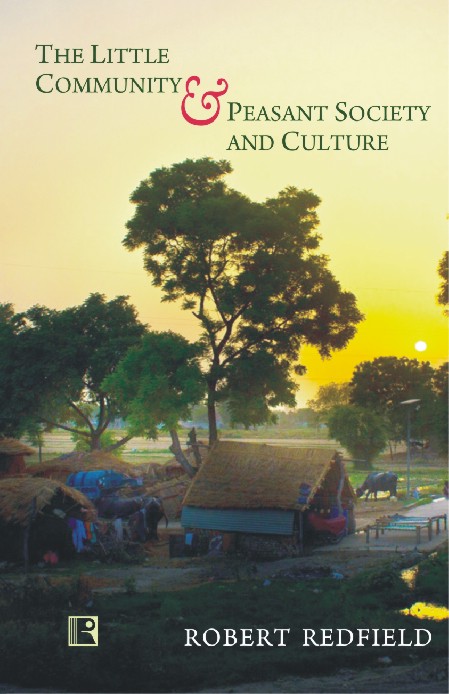
This volume combines two classic works of anthropology. The Little Community draws on the author’s own notable studies of the villages of Tepoztlan and Chan Kom to explore the means by which scientists try to understand human communities. It contains, wrote Margaret Mead, “the essence of Robert Redfield’s multifaceted contributions to the place of community studies in social science.” Peasant Society and Culture outlines a speculative foundation for the emergence of anthropology from the study of isolated primitive tribes.
Redfield’s study of the civilizations of China and India, which he visited, suggested his concept of civilizations as cultural systems of interdependent, coexisting “Great” and “Little” Traditions. He has dealt with these concepts in The Little Community and Peasant Society and Culture.
Contents
THE LITTLE COMMUNITY AS:
i. A Whole
ii. An Ecological System
iii. Social Structure
iv. A Typical Biography
v. A Kind of Person
vi. An Outlook on Life
vii. A History
viii. A Community within Communities
ix. A Combination of Opposites
x. Whole and Parts
PEASANT SOCIETY AND CULTURE
i. Anthropology and the Primitive Community
ii. Peasantry: Part-Societies
iii. The Social Organization of Tradition
iv. The Peasant View of the Good Life
About the Author / Editor
Robert Redfield (1897–1958), U.S. cultural anthropologist who was the pioneer and, for a number of years, the principal ethnologist to focus on those processes of cultural and social change characterizing the relationship between folk and urban societies.
He was associated with the University of Chicago for his entire career. His higher education took place at Chicago, and he then joined Chicago as faculty in 1927 and remained there until his death, also serving as Dean of Social Sciences from 1934–1946.