Jaipur • New Delhi • Bengaluru • Guwahati • Kolkata
Sujit Lahiry
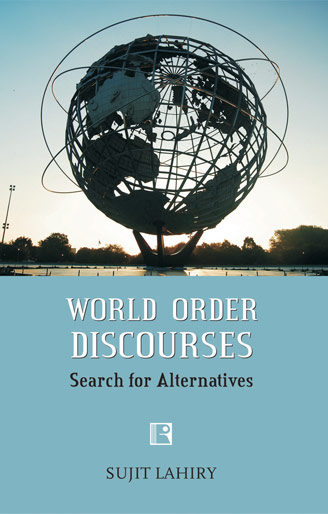
Scholarly interest in world order studies received a major boost in the late 1960s and early 1970s, when a group of eminent social theorists came together under the rubric of a major transnational research enterprise, World Order Models Project (WOMP). The WOMP theorists tried to lay down the bases of a normative world order based on four world order values, viz., peace, economic well-being, social and political justice, and ecological balance. WOMP was sponsored by what was earlier known as World Law Fund and was later re-designated as the Institute for World Order. This book discusses world order through the works of five seminal and prominent WOMP theorists—Richard Falk, Saul H. Mendlovitz, Samuel S. Kim, Rajni Kothari and Ali Mazrui. This book is also a critique of the WOMP studies and its projection of an alternative and Preferred World Order to be achieved by the 1990s. Additionally, I have tried to restructure WOMP in the contemporary world, especially given the fact that the contemporary notions and typology of world order are essentially positivistic in nature. The premises of such positivistic notions of world order have been critically examined. This book has thus taken the position that the contemporary world order can be made more humane and benevolent, if we adhere to the basic postulates of the WOMP theorists.
Sujit Lahiry had his higher education at the University of Delhi and Panjab University, Chandigarh. He has more than twelve years of teaching experience, including his stint at the University of Hyderabad for over a year. He has to his credit many research papers published in reputed journals and anthologies. His areas of specialization are in world order studies, South Asian studies, human security, civil society and new social movements. Presently, he is Assistant Professor in Political Science at Panjab University Regional Centre, Muktsar (Punjab).
Richard Sisson and Stanley Wolpert (eds)
Your cart is empty.