Jaipur • New Delhi • Bengaluru • Guwahati • Kolkata
Mridula Sharda
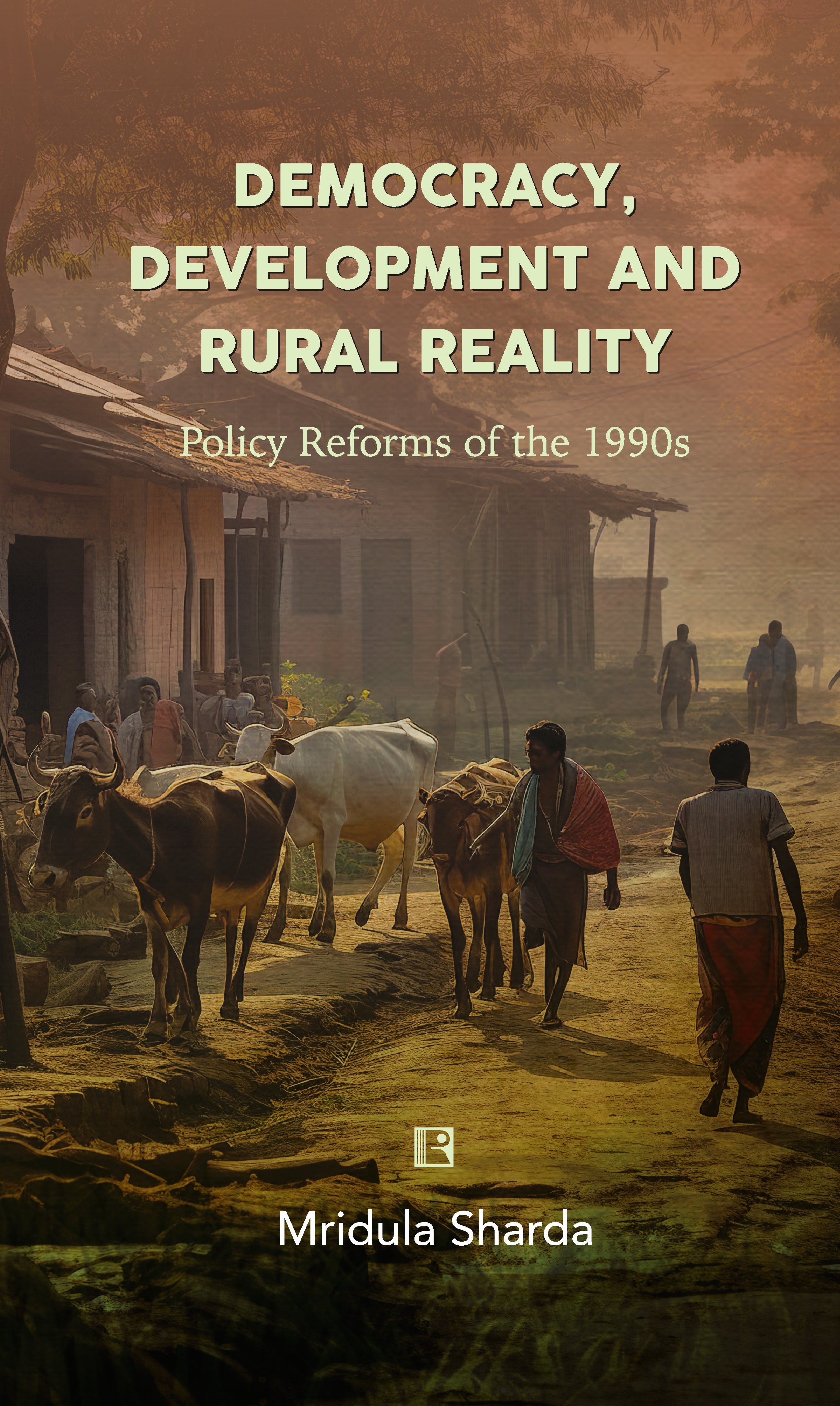
India’s journey since independence has been characterised by dynamic transitions. Democracy began as an ‘elite democracy’, marked by the constitutional establishment of local self-governance, and gradually evolved into a mass democracy – though elite influences have persisted even at the grassroots. This evolution reflects a continuous interplay between tradition and transformation.
The economic and political landscape underwent a significant shift in the 1990s. Liberalisation, Privatisation, and Globalisation (LPG) opened rural India to private sector participation, while the 73rd Constitutional Amendment institutionalised democratic decentralisation – empowering local communities to shape their own developmental trajectories.
This book explores three key dimensions: understanding the current role of local institutions, preparing them for the challenges of the 21st century, and examining how the narrowing gap between the global and the local is reshaping governance. The first two sections offer a critical analysis of policy frameworks and conceptual developments. The New Economic Policy (NEP) and its facilitation of corporate presence at the local level are examined through in-depth primary research in Himachal Pradesh – a state where rural communities have experienced the deep impact of the 1990s economic reforms. The study reveals that mass participation in democracy and development is bringing renewed vibrancy to grassroots politics.
This book is an essential read for academics, researchers, policymakers, and anyone seeking to understand the evolving dynamics and enduring inequalities in rural India.
Section I
Participation: Concept and Process
Development and Participation
Democratic Decentralization and Local Government
Revisiting Gandhi’s Idea of Decentralization: Village Swaraj in the Contemporary Context
Seventy-third Amendment in the Perspective of the 21st Century
Section II
Fiscal Federalism: Centralization and Decentralization
Political Parties’ Perception of Decentralization and Its Role Performance
Paradigms of the Economic Reforms, Democratic Decentralization and Tribal Society after 1991
Section III
Society and Economy of Himachal Pradesh
Panchayati Raj Institutions in Himachal Pradesh with Special Reference to HPPR Act 1994
Economic Reforms and Rural and Tribal Locale: A Case Study of Himachal Pradesh
Corporate Sector, Rural Masses and Local Leadership: A Case Study of the Ambuja Cement Limited (ACL), Darla Ghat, Himachal Pradesh
Section IV
Conclusion
Mridula Sharda is a distinguished academic currently serving
as Professor in the Department of Political Science at Himachal Pradesh Central
University. With over thirty-five years of dedicated experience in teaching,
research, and academic writing, she has made significant contributions to the
study of Indian polity, democratic decentralisation, tribal issues, and women’s
studies. Professor Sharda is the author of two major books and has published
more than sixty research papers in reputed national and international journals.
She has supervised twenty-five PhD and MPhil scholars, advancing scholarship in
political science and development studies. Her unwavering commitment to
understanding and transforming rural India is reflected in her extensive
fieldwork and incisive policy analysis. Her work remains essential reading for
scholars, policymakers, and anyone seeking a deeper understanding of grassroots
democracy and rural transformation in post-liberalisation India.
Richard Sisson and Stanley Wolpert (eds)
Your cart is empty.