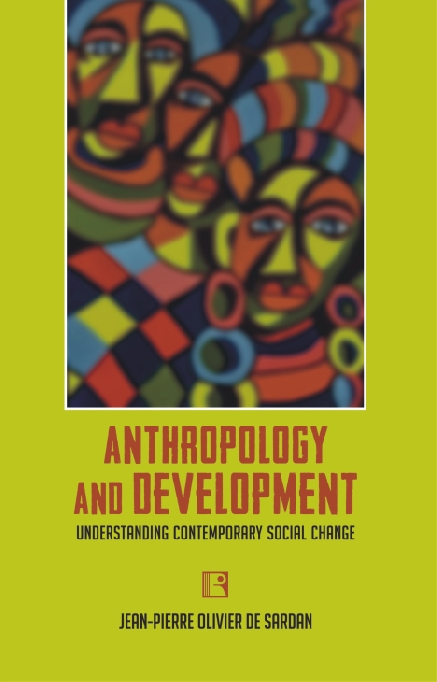
About the Book
The central purpose of this book is to re-establish the relevance of anthropological (and indeed sociological) approaches to development processes and, pari passu, persuading anthropology to recognise that the study of contemporary development ought to be one of its principal concerns. Professor Olivier de Sardan argues for a socio-anthropology of change and development that is a deeply empirical, multidimensional, diachronic study of social groups and their interactions, combining analysis of social practices and consciousness. It has, in his view, simultaneously to be a political anthropology, a sociology of organizations, an economic anthropology, a sociology of networks, and an anthropology of conceptions and belief systems.
The author also intends to make English- and French-speaking anthropologists and students much more aware of each other’s contribution to understanding development and social change.
The Introduction provides a thought-provoking examination of the principal new approaches that have emerged in the discipline during the 1990s. Part I then makes clear the complexity of social change and development, and the ways in which socioanthropology can measure up to the challenge of this complexity. Part II looks more closely at some of the leading variables involved in the development process, including relations of production; the logics of social action; the nature of knowledge, including popular knowledge; forms of mediation; and ‘political’ strategies.
Following its successful publication in French (where it has run through several printings), this important book will provoke much thoughtful debate about appropriate theory and practice within Anthropology, Sociology and Development Studies. It is also particularly appropriate as an advanced text for students in these fields.
Contents
• Introduction: The three approaches in the anthropology of development
• Socio-anthropology of development: Some preliminary statements
• Anthropology, sociology, Africa and development: A brief historical overview
• A renewal of anthropology?
• Stereotypes, ideologies and conceptions
• Is an anthropology of innovation possible?
• Developmentalist populism and social science populism: Ideology, action, knowledge
• Relations of production and modes of economic action
• Development projects and social logic
• Popular knowledge and scientific and technical knowledge
• Mediations and brokerage
• Arenas and strategic groups
• Conclusion: The dialogue between social scientists and developers
About the Author / Editor
Jean-Pierre Olivier de Sardan is Professor of Anthropology at the École des Hautes Études en Sciences Sociales in Marseilles and Director of Research at the Centre National de la Recherche Scientifique in Paris. Holding dual nationality in France and Niger, he was educated at the Sorbonne, and currently lives and works in Niamey. His long and distinguished research career has involved a huge number of different projects and activities, as well as long spells teaching at the University of Paris and other French universities, as well as in Africa. Between 1991 and 1996 he served as President of the Association Euro-Africaine pour l’Anthropologie du Changement Social et du Developpement. Since 1965 he has authored seven books in French, as well as contributing to numerous scholarly volumes and authoring many scholarly journal articles in French. He has also published articles in English language journals including Africa, Current Anthropology, Critique of Anthropology, Visual Anthropology, and the Journal of Modern African Studies, as well as chapters in several English language scholarly works.