Jaipur • New Delhi • Bengaluru • Guwahati • Kolkata
Francois Bourricaud
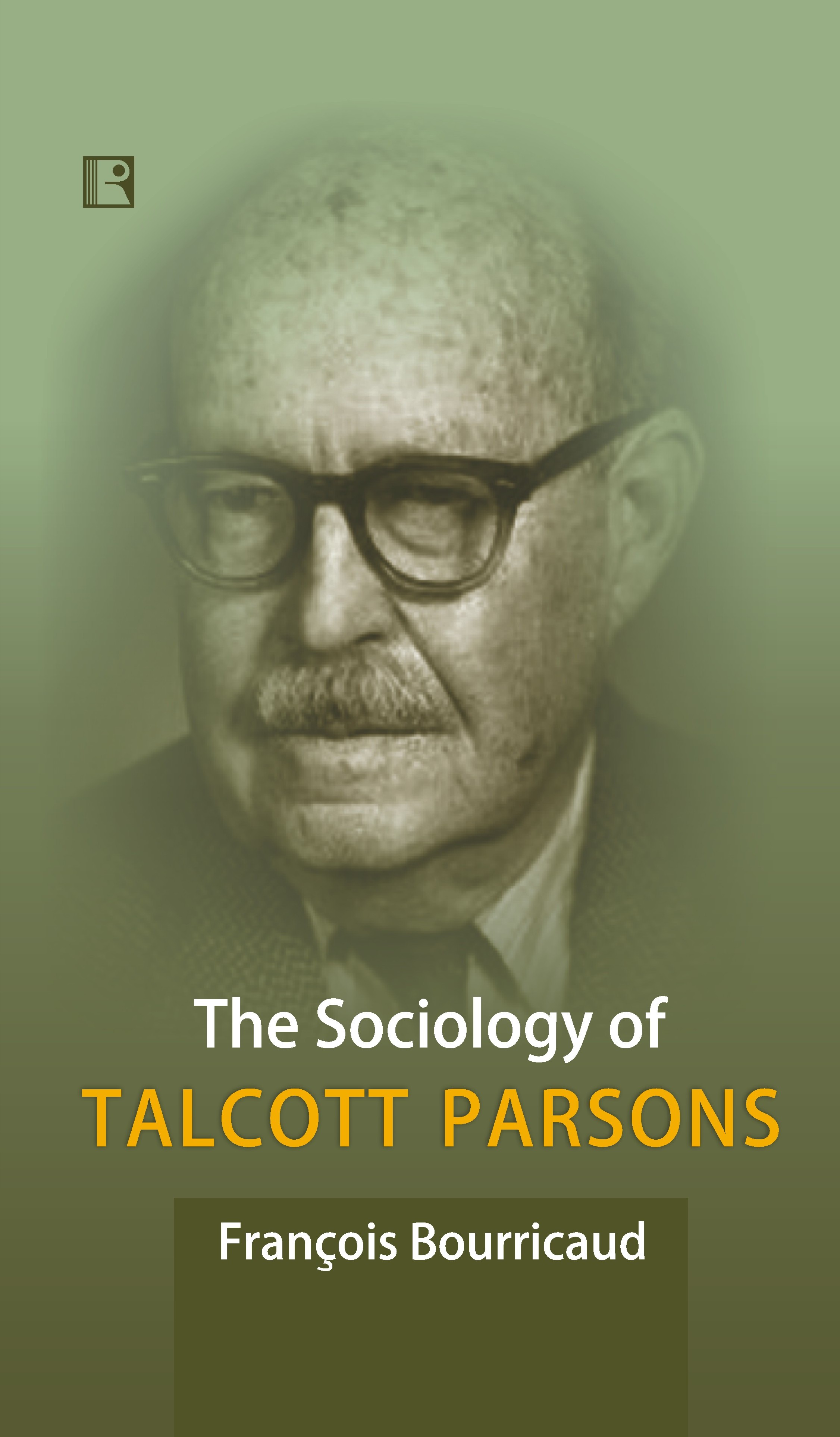
Talcott Parsons (1902–79) was a towering figure in social science. He had a direct hand in the education of three generations of sociologists, including Robert K. Merton, Kingsley Davis, Clifford Geertz, Robert Bellah, Neil J. Smelser, Bernard Barber, Jesse Pitts, and Renée Fox. In laying the foundations for a comprehensive general theory of human action, Parsons incorporated into sociology elements of biology, medicine, economics, anthropology, and Freudian psychology. Today his complex theory continues to generate the intense controversy – and frequent misunderstandings – that it has produced for several decades.
This volume makes available in English for the first time one of the most readable and accurate critical treatments of Parsons’s thought. It is probably the best introduction to his life work; Parsons himself was gratified by the original French edition and hoped that it would be translated. The book should do much to dispel many common mis-conceptions about Parsonian sociology. Contrary to the opinion of some, Parsons was not a strict “structural-functionalist.” Nor was he a utopian or a conservative ideologist. François Bourricaud shows that Parsons was more subtle, more realistic, and more empirical than he is often thought to have been. Throughout, Bourricaud is aware that he is dealing with a major theorist of the stature of Durkheim and Weber. As Harry M. Johnson writes in the Foreword, “Parsons continually went back to Durkheim, Weber, and Freud… and we shall continually go back to Parsons himself. And I have no doubt that every reader of François Bourricaud’s splendid book will return to it often for its own sake and for guidance to Parsons.”
CONTENTS
In this book...
• Foreword by Harry M. Johnson
• Introduction to Talcott Parsons
• The Starting Point
• The Alternative Orientations of Action
• The Social System
• The Political Subsystem
• Social Change
• Industrial Society
François
Bourricaud is Professor of Sociology at the Université René Descartes



Sukhadeo Thorat and Narender Kumar (Eds.)
Your cart is empty.