About the Book
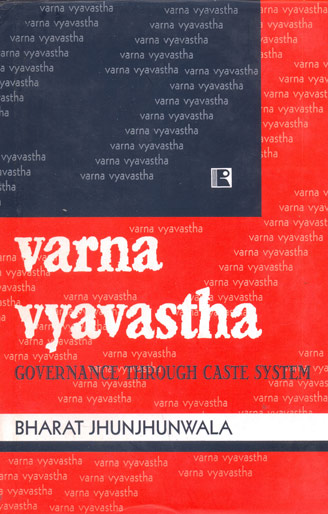
Varna Vyavasta: Governance through Caste System analyzes the varna vyavastha from the standpoint of governance. It shows that varna vyavastha reconciles the conflicting claims of evolution of individual and good governance in a synergetic manner.
Crucial to varna vyavastha is the concept of the Brahmin. A Brahmin is defined as a desire-based category and not as birth-based one. He is a person who has fulfilled his desires of physical pleasures, wealth and power and is now engaged in the pursuit of self-knowledge. He has no worldly desires to fulfill therefore he alone can check the tyranny of the politicians. The book gives a call to the ‘Brahmin’ so defined, spread over various occupations and including those among the dalit, to become conscious of their historical task of containing tyranny of the state and discharge the same.
Besides, the thoughts of notable historians like D.D. Kosambi and G.S. Ghurye; political leaders like B.R. Ambedkar, Mahatma Gandhi and Ram Manohar Lohia; and western philosophers like John Locke and Karl Marx have been examined to show how these affirm the concept of varna vyavastha.
Administrators, political scientists, social scientists and general readers will find this book of great interest.
Contents
About the Author / Editor
Bharat Jhunjhunwala was born in a family with strong industrial background. After graduating in science he acquired his doctoral degree in economics from University of Florida, USA at the age of 23. On his return he joined Indian Institute of Management, Bangalore as an Assistant Professor. While teaching, he lived in a slum for two years, organized trade unions and engaged himself in several other social activities.
He has undertaken extensive studies of economic thought of ancient India. Presently he is based in Delhi and writes a weekly column on political economy which is published in about 20 newspapers in five languages in India and abroad.