About the Book
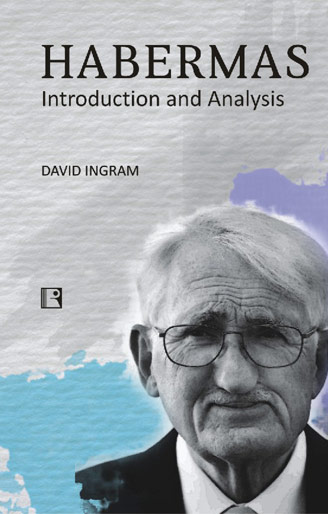
The work of Jürgen Habermas (b. 1929) has been highly influential both in philosophy and across many disciplines in the social sciences. David Ingram here provides an introduction to Habermas’s complex thought as it has evolved from 1953 to the present, spanning philosophy, religion, political science, social science, and law. One of today’s most intriguing thinkers, Habermas is also notably prolific; for students and other readers who wish to navigate the philosopher’s more than thirty books, the lucid and precise Habermas: Introduction and Analysis is a welcome starting point rich in insights.
Ingram’s book addresses the entire range of Habermas’s social theory, including his most recent and widely discussed contributions to religion, freedom and determinism, global democracy, and the consolidation of the European Union. Recognizing Habermas’s position as a highly public intellectual, Ingram discusses how Habermas applies his own theory to pressing problems such as abortion, terrorism, genetic engineering, immigration, multiculturalism, separation of religion and state, technology and mass media, feminism, and human rights. He also presents a detailed critical analysis of Habermas’s key claims and arguments.
Separate appendixes introduce and clarify such important concepts as causal, teleological, and narrative paradigms of explanation in action theory; contextualism versus rationalism in social scientific methods of interpretation; systems theory and functionalist explanation in social science; and decision and collective choice theory.
Contents
1. A Public Intellectual Committed to Reason
2. Habermas’s Defense of Psychoanalytic Social Science
3. The Linguistic Turn
4. Knowledge and Truth Revisited
5. Discourse Ethics
6. Law and Democracy: Part I: The Foundational Rights
7. Law and Democracy: Part II: Power and the Clash of Paradigms
8. Law and Democracy: Part III: Applying the Proceduralist Paradigm
9. Law and Democracy: Part IV: Social Complexity and a Critical Assessment
10. Crisis and Pathology: The Future of Democracy in a Global Age
11. Postsecular Postscript: Modernity and Its Discontents
About the Author / Editor
David Ingram is Professor of Philosophy at Loyola University, Chicago.