
Jaipur • New Delhi • Bengaluru • Guwahati • Kolkata
Aijazuddin Ahmad
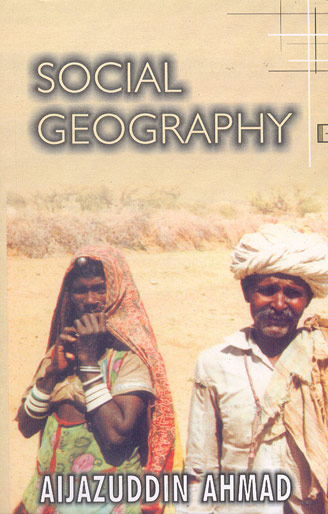
Admittedly, not much work has been done on the spatial organization of Indian society and its social structure as expressed in identities such as ethnicity, tribe, caste, community, language, dialect and religion at the grassroots level, although broad all-India outlines are discernible in stray research. The present work seems to serve two main purposes: First, it reconstructs the broader outlines at the all-India level, disaggregating the data wherever possible upto the regional levels. Secondly, it presents data in a historical context, thus demonstrating how crucial the spatial dimension is in understanding the socio-cultural evolution of the Indian people, as well as in realizing the significance of the socio-cultural diversity in the functioning of the federal polity in India today.
• SOCIAL GEOGRAPHY : An
introduction
• TOWARDS A SOCIAL GEOGRAPHY OF INDIA : Laying the foundations
• ORIGINS : Social differentiation and region formation
• TRIBE : Between the
two worlds
• CASTE : Everyone in
one’s own place
• LANGUAGE : A bridge,
not a cleavage
• RELIGION : Cast in
a regional mould
• AN OVERVIEW : Some preliminary conclusions
Aijazuddin Ahmad is a geographer with a brilliant academic record and notable professional achievements. He retired as Professor of Geography from the Jawaharlal Nehru University, New Delhi, where he served at the Centre for the Study of Regional Development from 1972 to 1997. He also taught at the Aligarh Muslim University, Aligarh, during the period 1962-1972. His earlier published works include: Demographic Transition, Social Structure and Regional Development, Mountain Population Pressure, An Atlas of Tribal India and The Valley of Kashmir.

Shruti Mathur and Rajendra Kumar
Your cart is empty.