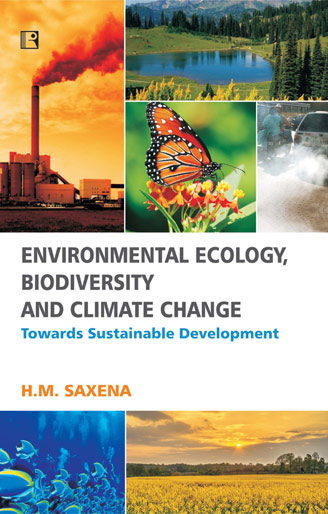
Jaipur • New Delhi • Bengaluru • Guwahati • Kolkata
Md. Nazrul Islam | André van Amstel (Eds.)
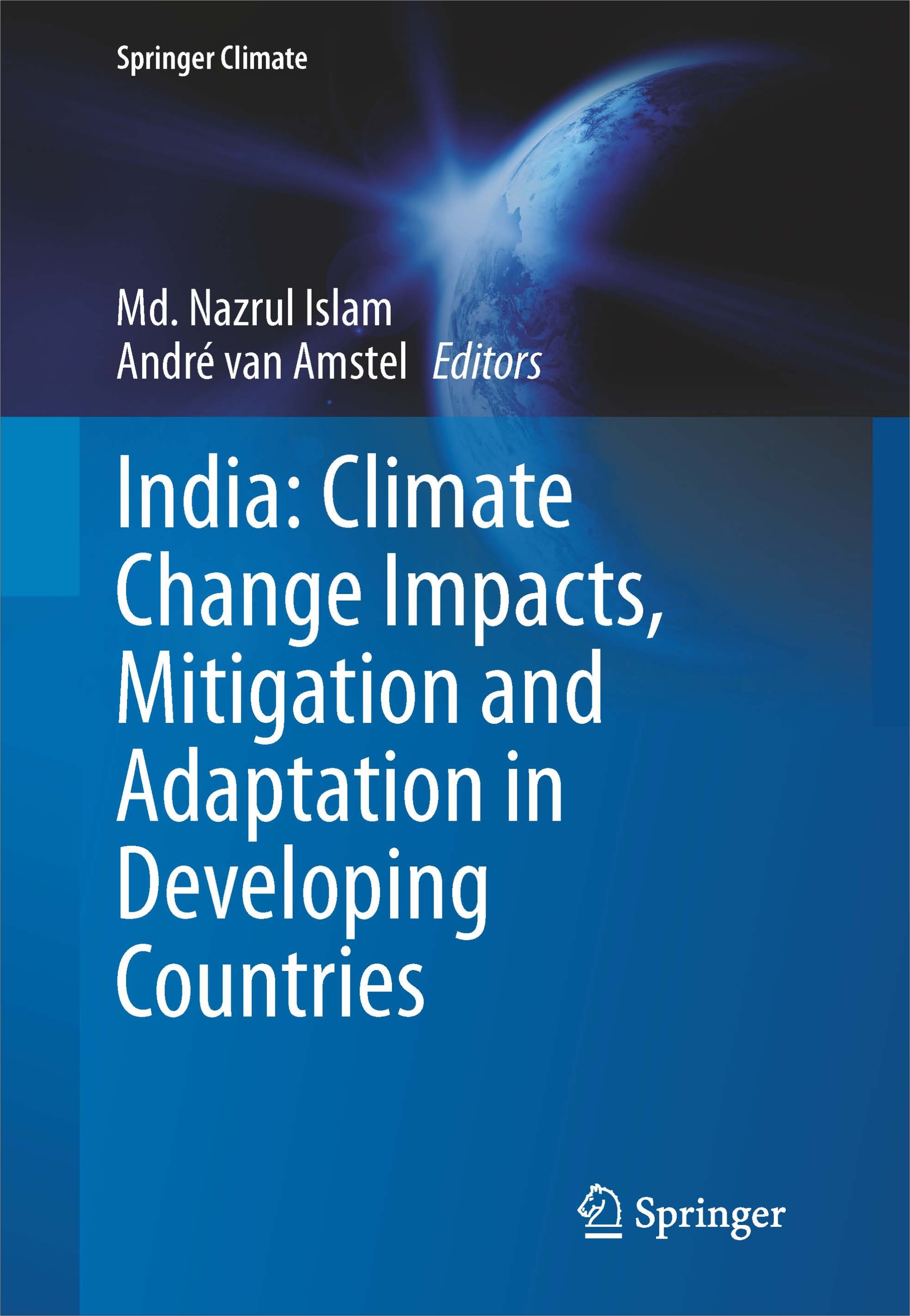
Climate change will lead to many changes in global development and
security especially energy, water, food, society, job, diplomacy, culture,
economy and trade. The Intergovernmental Panel on Climate Change (IPCC) defines
climate change as: “Any change in climate over time, whether due to natural
variability or as a result of human activity.” Global climate change has
emerged as a key issue in both political and economic arenas. It is an
increasingly questioned phenomenon, and progressive national governments around
the world have started taking action to respond to these environmental
concerns. This book discusses the issue of food and water security in India
under the context of climate change. It provides information to scientists and
local government to help them better understand the particularities of the
local climate. It offers insight into the changes to natural ecosystems which
have affected the local Indian population. Climate change is one of the biggest
challenges to Indian society. It can lead to serious impacts on production,
life and the environment. Higher temperatures and sea level rise can lead to
flooding and cause water salinity problems which bring about negative effects
on agriculture and high risks to industry and socio-economic systems in the
future.
1 New Challenges on
Natural Resources and their Impact on Climate Change in the Indian Context
Sunil Kumar
Srivastava
2 Regional Assessment
of Impacts of Climate Change: A Statistical Downscaling Approach
Nagraj S. Patil and
Rajashekhar S. Laddimath
3 Flood Risk
Assessment for a Medium Size City Using Geospatial Techniques with Integrated
Flood Models
Surendar Natarajan
and Nisha Radhakrishnan
4 Impact of Climate
Change and Adaptation Strategies for Fruit Crops
Tanmoy Sarkar,
Anirban Roy, Sanvar Mal Choudhary, and S. K. Sarkar
5 Evaluating
Adaptation Strategies to Coastal Multihazards in Sundarban Biosphere Reserve,
India, Using Composite Adaptation Index: A Household-Level Analysis
Mehebub Sahana,
Sufia Rehman, Shyamal Dutta, Samsad Parween, Raihan Ahmed, and Haroon Sajjad
6 Impact of Climate
Change on Groundwater Resource of India: A Geographical Appraisal
Sutapa Mukhopadhyay
and Amit Kumar Mandal
7 Comparison of
Classical Mann–Kendal Test and Graphical Innovative Trend Analysis for Analyzing
Rainfall Changes in India
Tapash Mandal,
Apurba Sarkar, Jayanta Das, A. T. M. Sakiur Rahman, and Pradip Chouhan
8 Forest Phenology as
an Indicator of Climate Change: Impact and Mitigation Strategies in India
Priyanshi Tiwari,
Pramit Verma, and A. S. Raghubanshi
9 Assessment of Stream
Flow Impact on Physicochemical Properties of Water and Soil in Forest Hydrology
Through Statistical Approach
Malabika Biswas
Roy, Pankaj Kumar Roy, Sudipa Halder, Gourab Banerjee, and Asis Mazumdar
10 Impact of Climate
Extremes of El Nina and La Nina in Patterns of Seasonal Rainfall over Coastal
Karnataka,
A. Stanley Raj and
B. Chendhoor
11 Geothermal Energy
and Climate Change Mitigation
Kriti Yadav,
Anirbid Sircar, and Apurwa Yadav
12 Trends and Pattern of
Rainfall over Semiarid Sahibi Basin in Rajasthan, India
Manpreet Chahal,
Pankaj Bhardwaj, and Omvir Singh
Md. Nazrul Islam is a Professor at the Department of
Geography and Environment in Jahangirnagar University, Savar, Dhaka-1342,
Bangladesh. Prof. Nazrul has completed his Ph.D. from the University of Tokyo,
Japan. Besides, he has completed Two Year Standard JSPS Postdoctoral Research
Fellow from the University of Tokyo, Japan. His fields of interest are
environmental systems modeling, climate change impact on aquatic and marine
ecosystem especially phytoplankton transition, harmful algae by coupling
hydrodynamics numerical model on coastal seas, bays and estuaries etc. Prof.
Nazrul has made more than 40 scholarly presentations in more than 20 countries
around the world, authored more than 110 peer-reviewed articles and authors of
10 books and research volumes. Prof. Nazrul has published an excellent book
entitled “Environmental Management of Marine Ecosystems” jointly with late
Prof. Sven Erik Jorgensen by the CRC press (Taylor & Francis). He has also
edited an excellent book entitled: Bangladesh I: Climate Change Impacts,
Mitigation and Adaptation in Developing Countries, Springer Publication, the
Netherlands & Germany. Prof. Nazrul is currently serving as an “Executive
Editor-in-Chief” of the journal “Modeling Earth Systems and Environment”,
Springer Publications (Journal no. 40808). Andre van Amstel is an Assistant Professor at
Wageningen University and Research, the Netherlands. Andre van Amstel studied
Physical Geography and Planning in Amsterdam and has a long standing expertise
in Integrated Environmental Assessment. He contributed to the development of
Integrated Model to Assess the Global Environment at the Institute of Public
Health and the Environment in the Netherlands. He is particularly interested in
the global environment and the risk of a runaway greenhouse effect by
methanefrom melting of the permafrost in the Arctic. Van Amstel contributed to
the IPCC 2006 Guidelines on Agriculture, Forestry and Land use and as such contributed
the Nobel Peace Prize 2007 for Al Gore and the IPCC. Since 2014 he is a member
of the Nordforsk Scientific Advisory Board for the Arctic Council of Ministers
on Arctic Integrated Environmental Research.
Martin F. Price, Alton C. Byers, Donald A. Friend, Thomas Kohler and Larry W. Price (eds)
Your cart is empty.